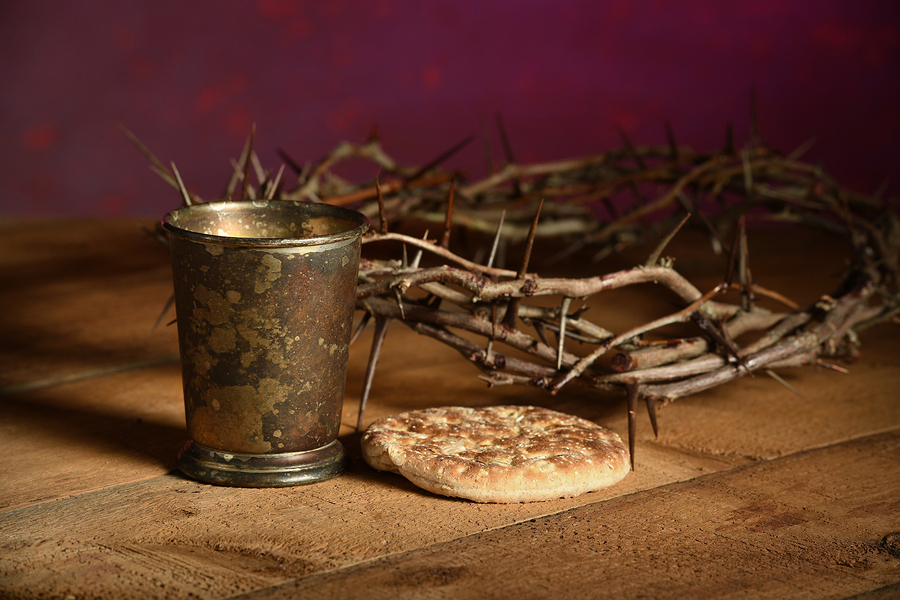
Join the brothers of the Society of St. John the Evangelist for Holy Week prayers, scripture readings, videos and sermons. Each day of Holy Week offers a fresh invitation to engage with this most sacred season. Go to https://www.ssje.org/praying-holy-week/ to participate.
Author: Marjorie George
Spiritual Formation for Lent 2018
Praying through the words of John the Evangelist is the focus of Meeting Jesus in the Gospel of John for Lent 2018. John’s gospel and his First Epistle describe how God, out of deep love, sent God’s only Son Jesus into the world to take on human form and live among us. By learning from Jesus, his human friendships and his teachings about the God he calls “Father,” study participants will discover God as One who longs for deep intimacy with each of us.
Study participants will use a beautiful 60-page journal to reflect and meditate on a daily verse from John through words, images, or however the Spirit leads. The journal can be downloaded for free or purchased from Amazon.
Participants may also subscribe online to receive a daily short video in which a monastic brother from the Society of Saint John the Evangelist will share comments on the daily Gospel verse, having a relationship with Jesus, and possibilities for further reflection.
The program is ideal for individuals or small groups. Materials available include small-group facilitator guides for several types of groups including Sunday-morning forums.
This offering has been designed and produced by the Society of Saint John the Evangelist (www.ssje.org), a religious order for men in the Episcopal Church, and by the Center for the Ministry of Teaching of the Virginia Theological Seminary in Alexandria, Virginia (www.vts.edu/cmt).
To learn more about this study and to register, go to Meeting Jesus in the Gospel of John.
Lent begins with Ash Wednesday, February 14.
Epiphany Study from Migration Ministries

Episcopal Migration Ministries is offering an Epiphany Curriculum, which includes free resources to oversee a faithful and meaningful Epiphany 2018.
“After the celebration and joy of Christmas, the Church turns its attention to the Epiphany of Christ, and a season when we remember time and again how God is made manifest in the world,” noted the Rev. Canon E. Mark Stevenson, Director of Episcopal Migration Ministries. “In these important days, Episcopal Migration Ministries invites congregations and faith communities to reflect on the rich history of the Episcopal Church’s work among refugees, as we have answered collectively the revealed Son of God’s call to be his ministers in a hurting world.”
Designed for Adult Christian Formation, the six-week Epiphany Curriculum is ideal for congregations, individuals, adult forums, discussion groups, and other church-based gatherings. “Participants will come away with a deeper understanding of Episcopal Migration Ministries, refugee resettlement, the stories of our new American neighbors, and how God is calling each of us into this work,” Stevenson said.
Click here for the Epiphany Curriculum.
“It was the story of the Holy Family’s flight into Egypt as refugees that inspired Episcopalians in Southern Ohio in the 1930s to offer refuge to those fleeing Nazi Europe,” Stevenson added. “So, too, do we hear that same story this Epiphany season and recommit ourselves to ministry among the 65 million children, women, and men who have fled their homes in our days because of violence or persecution. Each one of these children of God is a person with a name and a story, each with hopes and dreams, and all deserving of peace and opportunity. Through this educational resource, Episcopalians can come to know these stories, offer possibility to those hopes, and provide for the realization of such peace and opportunity.”
Episcopal Migration Ministries is a ministry of the Episcopal Church, and is one of nine national agencies responsible for resettling refugees in the United States in partnership with the government. Episcopal Migration Ministries currently has 22 affiliate offices in 17 states.
O Antiphons: O Emmanuel . . . come and save us

December 23
O Emmanuel (Isaiah 7:14) :
“O Emmanuel, you are our king and judge, the One whom the peoples await and their Savior. O come and save us, Lord, our God.”
From Marthe Curry
Picture two old souls who hunger deeply for the coming Messiah. Shattered memories of a kingdom destroyed by disobedience, decades of exile under heartless oppressors, and humiliation at the hand of Roman conquerors cannot diminish eyes whose faith sees and waits for Messiah.
Simeon and Anna are no strangers to the temple. Temple is home to Anna, and she and Simeon must often have watched and spoken of the Promise. Engraved on their hearts are the words of Isaiah, of God’s coming to be with them — Emmanuel. Despite years of disappointment, of widowhood for Anna, of grave injustices at the hands of their conquerors, and hypocrisy characterizing the religious leaders of the day, Simeon and Anna continue to linger.
They linger, for they believe. And one day, “moved by the Spirit, [Simeon goes] into the temple courts.” And there “at that very moment” faithful Anna and Simeon see the Child, the one who will be “a light for revelation to the Gentiles, and the glory of your people Israel”—Emmanuel, the Christ Child, God with us.
May this deep longing for the presence of the living God with and in us fill our hearts as we, like Simeon and Anna, stand in anticipation, trusting, and waiting expectantly for the revelation of Emmanuel, Desire of the nations, Savior of all people who will come, as promised, and set us free.
Marthe Curry is the director of the Department of World Mission for the Episcopal Diocese of West Texas. Reach her at mcurry@sbcglobal.net.
Photography by the Rev. Doug Earle. See more of Doug’s work at Www.DougEarlePhotography.com.
The well-known Advent hymn O Come O Come Emmanuel recalls the prophet Isaiah’s several descriptions of the coming Messiah. During the seventh and eighth centuries, these descriptions were compiled into antiphons and were recited before and after the Magnificat during Vespers or Evening Prayer for the seven evenings preceding Christmas.
We present these O Antiphons from December 17 to December 23 along with meditations from writers across the diocese and the photography of the Rev. Doug Earle.
 Adult Christian Formation